07Quarterly
 Weight And Momentum
How movement feels, measured
Weight And Momentum
How movement feels, measured
Three people, a capture card and a controller in a clamp. There is no office and no schedule beyond four issues a year.
Weight And Momentum
How movement feels, measured
Three people, a capture card and a controller in a clamp. There is no office and no schedule beyond four issues a year.
This began as an argument about a single jump that neither participant could win, because neither had anything to point at. Seven issues later the pointing is the entire method.
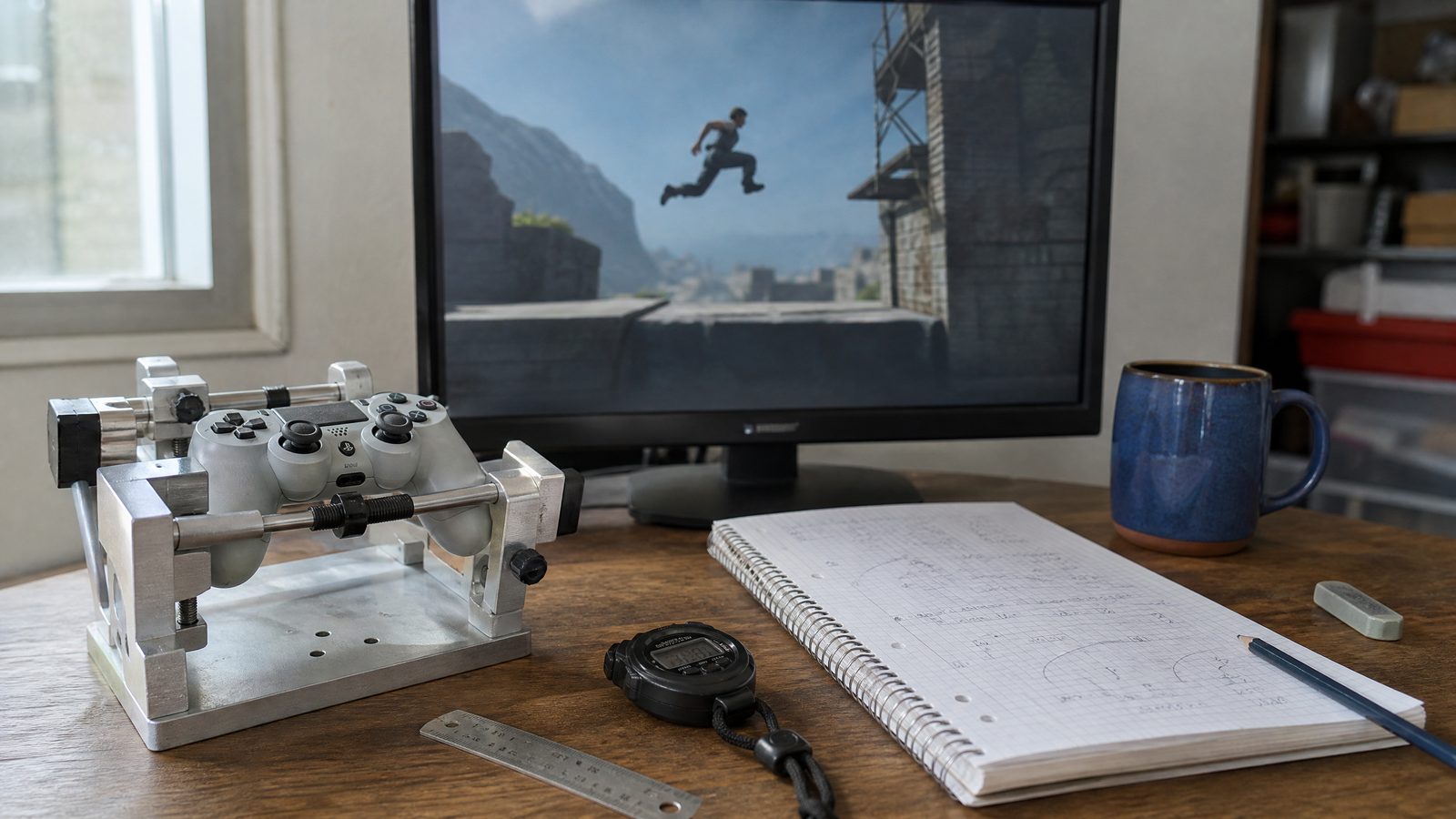
Three of us play games and two of us had spent about a decade disagreeing about whether a particular action game felt heavy or slow. The disagreement was unresolvable because it was conducted entirely in adjectives: one of us said weighty, the other said sluggish, and both were describing the same eleven frames of acceleration without knowing the number existed.
The first measurement was taken to end that argument and did not end it. What it did was change the argument into something worth having. Once both parties agreed that the character reached full speed in eleven frames and stopped in nineteen, the question became whether that asymmetry served the game — which is a real question with evidence on both sides, and which we are still arguing about in this issue's lead review.
Movement is the part of a game a player touches most and the part described least precisely. A twenty-hour game might contain three hours of combat and one of dialogue; it contains twenty hours of moving. A movement system that is two frames wrong is wrong for the whole duration, and the vocabulary available for discussing it — tight, floaty, weighty, responsive — collapses the moment two people use it.
So we count frames, establish scales, log outcomes and publish the procedures. Not because numbers settle questions of quality, which they cannot, but because they make the disagreement specific enough to be productive. The method page is explicit that no figure here is a score.
The numbers do not settle the argument. They relocate it somewhere the participants can both stand.
Each game is played independently by at least two of us before any measurement is taken, and the measurements are taken by whoever did not write the first draft. Where we disagree about a verdict, the review says so and prints both positions — review five in this issue contains an unresolved disagreement about whether hidden assistance should be disclosed to players, and none of us expects to win it.
The reason for printing disagreement rather than resolving it editorially is that a single verdict from three people who disagree is a fiction, and this publication's whole premise is that the vague consensus is the problem.
Every game is bought at retail. We accept no review copies, no early access, no press events and no advertising, and there is nothing on this site to click that costs anyone money. A quarterly that publishes several months after a release date is useless to a marketing calendar, which removes most of the pressure other publications have to manage.
There is no funding and no plan for any. The costs are a capture card, some games and a great deal of time, and the three of us have other work.
Two figures across seven issues have been wrong, both found by readers who repeated the measurement, and one of them changed a review's conclusion. Both are described openly on the bench page, and the second is why the second bench note in this issue exists at all.
That is the closest thing this publication has to a mission: publish the procedure, publish the figures, and be corrected in public when the figures are wrong. Anyone with a capture card and patience can check any number in issue seven, and we would prefer that they did.