07Quarterly
 Weight And Momentum
How movement feels, measured
Weight And Momentum
How movement feels, measured
Weight And Momentum
How movement feels, measured
Weight And Momentum
How movement feels, measured
The best movement system in the issue, and the one that gives the player least authority. A step, once begun, completes. Turning is a sequence rather than an input. Everything about it is slow, and none of it is imprecise.
18 hours · Step cadence and camera frequency measured separately · Three chassis compared
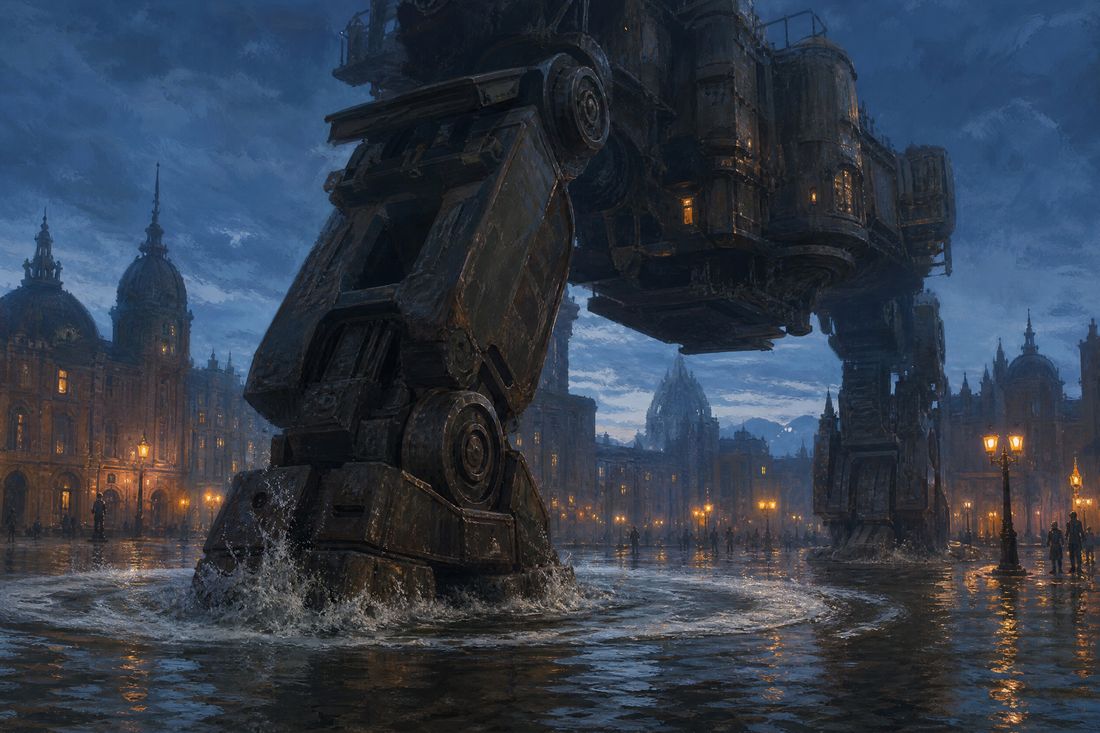
The machines in this game are stated at twenty-two tonnes and they behave like it, which after review three is a considerable relief. But mass is not what makes this system the best in the issue. What makes it the best is that the game has understood something most heavy-movement games have not: weight is not a delay, it is a commitment structure.
A delay would mean pressing forward and waiting. That is what most games do with mass and it is why heavy vehicles are usually tedious. Here, pressing forward initiates a step — a discrete, animated, 1.4-second event with defined phases — and the player's input is a decision about which step to take next rather than a request for continuous motion. The machine is never waiting. It is always mid-commitment.
| Phase | Frames | Player authority |
|---|---|---|
| Weight shift onto planted leg | 9 | Full — step can be aborted |
| Leg lift and swing | 31 | None |
| Foot placement | 18 | None |
| Settle and load transfer | 26 | Next step can be queued |
| Total | 84 (1.4s) | — |
The nine-frame abort window at the start is the whole design in miniature. It is long enough that a player who changes their mind immediately is not punished, and short enough that a player who commits is committed. Both of us, independently, learned to use it as a feint against other machines, which the game neither teaches nor mentions.
Turning is where the system is boldest. There is no turn rate in the usual sense; instead, turning is executed as a sequence of pivot steps, each with the same phase structure, giving an effective rate of eighteen degrees per second. A hundred and eighty degree turn takes ten seconds and cannot be hurried. In a combat game this is close to unthinkable, and it works because every opponent is under the same constraint.
We measured the camera shake frequency against the step cadence expecting them to match, because matching is the obvious choice and what most games do. They do not match. Step cadence is 0.71 hertz; the dominant shake frequency is 0.78. The offset is small, consistent and, we are confident, deliberate.
What it produces is a machine that reads as straining rather than marching. A camera locked to the step cadence produces rhythm, and rhythm reads as ease; a camera slightly out of phase produces beating, and beating reads as effort. It is the single most sophisticated piece of movement presentation we have measured, and it is entirely invisible as a technique.
Locked to the step, the machine marches. Seven hundredths of a hertz off it, the machine strains. Nothing else changed.
Compare review one, where camera acceleration lagging character acceleration by four frames is what produces the sensation of mass. Both games do their real work in the camera, and neither says so.
Chassis choice alters the figures substantially and coherently. The light chassis has a 0.9-second step and a twenty-nine-degree turn rate; the heavy has 1.9 seconds and eleven degrees. Every derived figure — abort window, queue window, settle time — scales in proportion, which means the light chassis is not simply a faster version of the heavy but a different commitment structure with a shorter unit of decision.
The abort window is nine frames on all three chassis. On the light chassis that is 10% of a step; on the heavy it is 4%. The heavy chassis is therefore proportionally less forgiving in a way the interface never indicates.
We think this is deliberate — the heavy chassis should punish indecision — but it is the one figure in the game we would want stated somewhere.
Everywhere, and quickly. There is no version of this movement system that is pleasant in the first twenty minutes, because the vocabulary takes about two hours to acquire and until then the machine simply feels broken. The game makes no concession to this: no simplified control mode, no faster tutorial chassis, no acknowledgement that the player is learning a language.
That is a defensible position and it is the same one review one takes, but this game has less excuse. Its entire combat model depends on reading opponent commitments, and a five-minute sequence demonstrating a telegraphed step would teach more than the two hours the player currently spends inferring it.
The other loss is traversal distance. Nothing in this game is close to anything else, and at eighteen degrees per second and 1.4 seconds per step, crossing a map is a project. Two of the late missions are, in practice, ten minutes of walking with four minutes of combat in them, and the walking is not interesting the third time.