07Quarterly
 Weight And Momentum
How movement feels, measured
Weight And Momentum
How movement feels, measured
Weight And Momentum
How movement feels, measured
Weight And Momentum
How movement feels, measured
This game is helping you constantly and never admits it. Release the stick mid-run and 82% of speed persists for eleven frames. Mistime a vault and you get a slower vault rather than a fall. It took us nine hours to notice and the rest of the review to decide whether that is honest.
18 hours · 96 vault attempts logged frame by frame · Default configuration
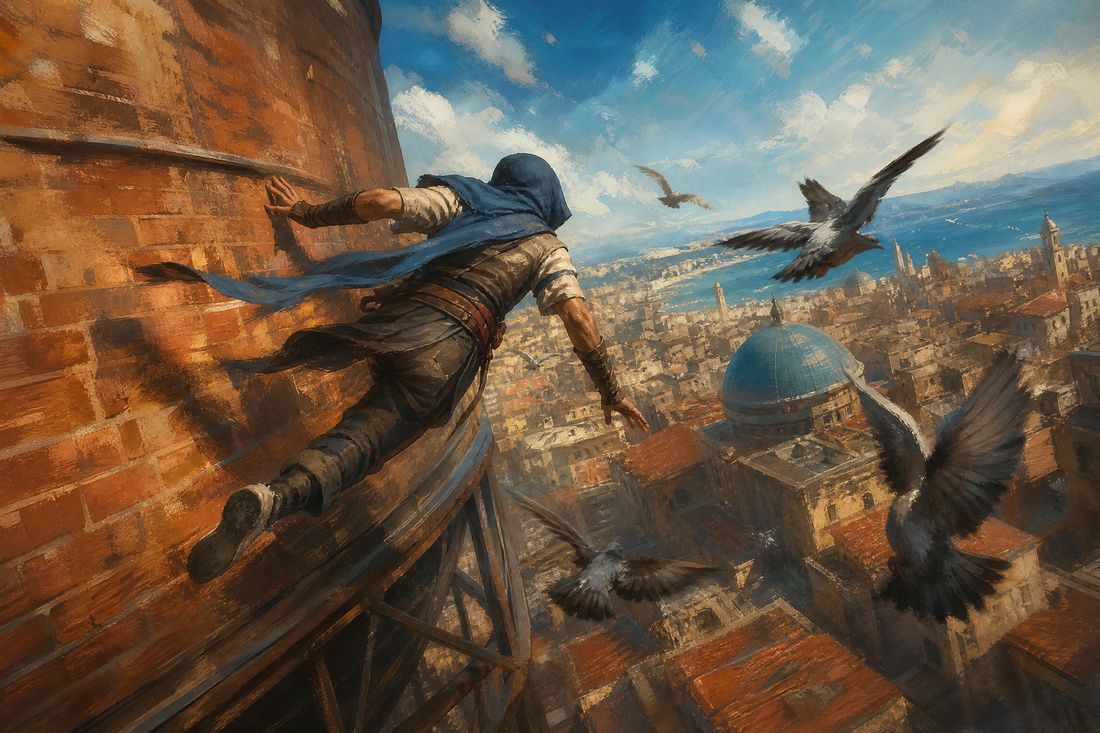
The pleasure of a traversal game is the sensation of doing something difficult fluently, and there are two ways to produce it. One is to make the player good, which takes hours and loses most of them. The other is to make the game quietly absorb error so that a mediocre player's inputs resolve into a competent-looking run. This game does the second, extensively, and does not tell anyone.
We did not set out to find it. The intention was a straightforward measurement of run speed and vault timing, and the anomaly appeared in the deceleration figures: released inputs were not decaying the way the animation suggested. Nine hours in, one of us released the stick at full speed and watched the character continue for what looked like a fifth of a second, and the review changed shape.
| Mechanism | Measured | Visible to player |
|---|---|---|
| Speed retained on release | 82% for 11f | No |
| Vault input window | 14f | No |
| Late input result | Slower vault | Partially |
| Ledge grab range | 1.4× visual | No |
| Wall-run re-entry | Auto within 6f | No |
| Fall conversion | 63% of near-misses | No |
The last row is the significant one. Of the near-missed jumps we logged — cases where the character's trajectory, taken literally, would not have reached the ledge — sixty-three per cent resolved into a successful grab. The remainder produced falls. There is a threshold, we could not determine it exactly, and below it the game simply decides you made it.
Fourteen frames of vault window is also generous but not exceptional; comparable games sit between eight and sixteen. What distinguishes this one is that a late input does not fail, it degrades: press at frame sixteen and the character performs a slower, uglier vault with a speed penalty rather than colliding with the obstacle. The player reads this as their own sloppiness. It is in fact the game covering for them.
Reader three argued through most of the drafting that it is. The claim is that a player who believes they are executing precisely, and is in fact being carried, has been denied the thing traversal games are for — earned competence. If sixty-three per cent of near-misses are converted, then a substantial fraction of the player's best moments were not theirs.
The counter-argument, which is the position this review takes, is that the alternative is worse and the comparison in this issue proves it. Review four covers a game that assists the player almost not at all, and the result is a movement system that is more honest and considerably less enjoyable. Assistance is not a compromise of a traversal game; it is the mechanism by which traversal games work. The only real question is whether the assistance is well-tuned.
Every fluent traversal game is generous. The good ones are generous at a scale the player cannot detect.
Here it is well-tuned in one respect and poorly in another. Well-tuned: the eleven-frame speed retention, which is short enough that a deliberate stop still reads as a stop, and long enough that momentum survives the small input gaps a human hand produces. Poorly: the ledge grab range at 1.4 times the visual reach, which is large enough to be noticed once you know, and which makes some jumps look like errors that succeeded.
Level design that would be impossible otherwise. Because the systems absorb error, the routes can be dense — direction changes every second or so, with no recovery gaps built in for the player to reset. We measured one late-game rooftop sequence containing nineteen distinct traversal actions in twenty-two seconds, which no unassisted movement system could support at a difficulty most players would tolerate.
The camera deserves specific credit. Unlike the zero-gravity game, this one damps its camera aggressively during fast movement and reduces field of view by a measured eight degrees during wall-runs, which both eases motion discomfort and makes the speed read as faster than it is. Neither effect is announced.
Automatic wall-run re-entry within six frames of falling off a wall produces, occasionally, a visible snap — the character's position corrects laterally by a distance large enough to see.
It happened four times in eighteen hours, always in the same architectural situation, and each time it broke the illusion the rest of the system maintains flawlessly.
The game is excellent and its generosity is why. Whether a player should be told is a real question and this review does not resolve it: reader three still thinks an option to disable assistance should exist, and the other two think such an option would be selected by almost nobody and would produce a worse game for those who did. What is not in dispute is that the tuning is skilled, deliberate and, in six of its seven mechanisms, invisible.