07Quarterly
 Weight And Momentum
How movement feels, measured
Weight And Momentum
How movement feels, measured
Weight And Momentum
How movement feels, measured
Weight And Momentum
How movement feels, measured
Every non-interactive element of this game insists that its vehicles are enormously heavy. The handling model disagrees, by a factor of roughly four, and the disagreement is the reason the game never quite works despite being competent in every other respect.
21 hours · Four vehicles measured across three surfaces · Assists disabled where the game permits
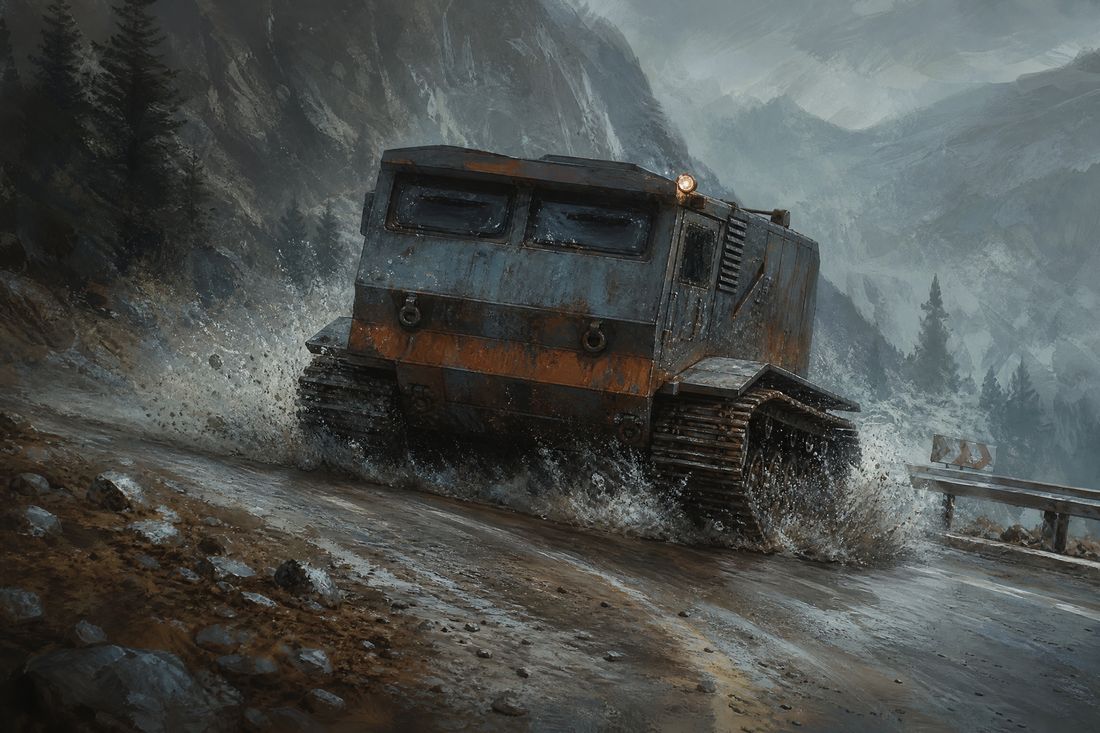
This is the negative review in issue seven and it is worth being precise about why, because the game is not incompetent. The tracks are well built, the surfaces are differentiated, the vehicles look magnificent and the audio work on the drivetrain is the best in the issue. What is wrong is a single relationship: between what the game says its vehicles weigh and what its physics does with them.
Mass is stated explicitly in the vehicle selection screen, which is unusual and is what made this measurement possible. The heaviest vehicle is given as sixteen tonnes. We measured its stopping distance, cornering behaviour, weight transfer under braking and recovery from a slide, and compared each against the same vehicle with the figure reduced in our estimation model until the numbers agreed. They agree at about four tonnes.
| Property | Measured | Consistent with 16t |
|---|---|---|
| 60 to 0 on tarmac | 31m | ≈78m |
| 60 to 0 on gravel | 44m | ≈110m |
| Slide recovery | 7f | ≈26f |
| Weight transfer under brake | Slight | Pronounced |
| Turn-in delay | 3f | ≈9f |
| Kerb strike deflection | Minor | Severe |
The turn-in figure is the one a player notices first without knowing what they are noticing. Three frames between steering input and the front of the vehicle beginning to rotate is a light-car number. It makes the vehicle pleasant to place and completely undermines the impression the rest of the game has spent its budget building.
Kerb strikes are the clearest single demonstration. Drive a stated sixteen tonnes over a raised kerb at speed and the vehicle should be substantially disturbed; here it hops, settles within four frames and continues on line. The animation is beautiful. The physics is of a vehicle that could be pushed by hand.
We have argued in this issue that realism is not the standard — review two praises a character with no mass whatsoever. The objection here is not that the physics is unrealistic but that the game has told the player what to expect and then not delivered it. A player who is shown sixteen tonnes, hears sixteen tonnes and sees suspension modelled for sixteen tonnes builds a model of the vehicle, and every corner then contradicts that model.
The result is a specific and unusual kind of dissatisfaction. The game is easy to drive well and does not feel like an achievement to drive well, because the difficulty the presentation promised never materialises. Both of us independently stopped caring about clean laps around the eight-hour mark, and neither of us could say why until the figures were on the page.
A game may model whatever physics it likes. What it may not do is describe one set of physics and run another.
The lightest vehicle in the roster, stated at 1.9 tonnes, behaves exactly as a 1.9-tonne vehicle should, and driving it is the best experience in the game. Stopping distances scale correctly, weight transfer is visible, kerbs are punishing and turn-in is immediate because it ought to be. We measured it three times looking for an error and found none.
This is fairly strong evidence about what happened during development: the handling model was built and tuned around a light vehicle and then applied, with insufficient scaling, to a roster that grew heavier. It is a common failure and rarely as measurable as it is here, precisely because most games do not print the masses.
Three of the six discrepancies are single-value problems: braking coefficient, slide recovery rate and kerb deflection magnitude. Correcting those would close most of the gap without rebuilding the model, at the cost of making the heavy vehicles considerably harder to drive.
The remaining three — weight transfer, turn-in delay and suspension response — are structural, and would require the model to treat mass as a real input rather than a label.
It would be unfair to end on the failure without recording what the game gets right. Surface differentiation is excellent and measurable: gravel adds 42% to stopping distance over tarmac, wet tarmac 27%, and both figures are consistent across the roster and across repeated runs. Very few driving games we have measured are this consistent between surfaces.
The audio, likewise, is doing real informational work rather than decoration. Loss of traction is audible between two and four frames before it is visible, which is genuinely useful and is the main reason a skilled player can drive this game quickly. It is a shame that the information is about a vehicle that does not weigh what the game says it weighs.