07Quarterly
 Weight And Momentum
How movement feels, measured
Weight And Momentum
How movement feels, measured
Weight And Momentum
How movement feels, measured
Weight And Momentum
How movement feels, measured
Push off a wall badly and there is no correction available. No thrusters, no air resistance, no generous snap to the nearest handhold — just the vector you chose and however long it takes to reach something. We logged four hundred pushes to find out how often that goes wrong.
17 hours · 412 pushes logged across three modules · No assistance options exist
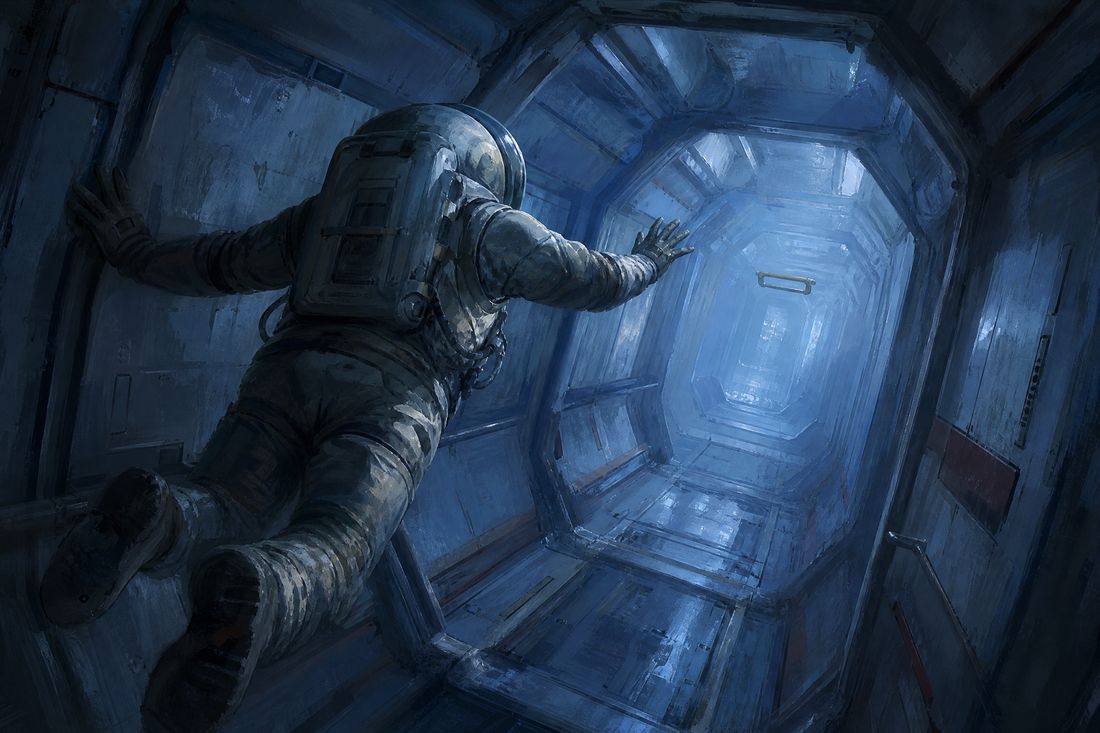
Almost every game set in zero gravity cheats, and the cheating is defensible: undamped floating is disorienting, slow and frustrating, so games add thrusters, add drag, add magnetic boots, or quietly curve the player's trajectory towards the handhold they were probably aiming at. This game does none of those things, and the seventeen hours we spent with it were the least comfortable in the issue and the most interesting to measure.
The movement model is close to the simplest possible. The player grips a surface, aims, and pushes with a force determined by how long the input is held. From that moment the character is ballistic: constant velocity, no damping, no steering, no ability to slow down. Contact with any surface ends the drift, and contact is entirely a matter of whether the vector was right.
| Outcome | Count | Share |
|---|---|---|
| Reached intended handhold | 268 | 65% |
| Reached a different surface within 2s | 91 | 22% |
| Drift of 2–5 seconds | 38 | 9% |
| Drift of 5–9 seconds | 13 | 3% |
| Drift ended in hazard | 2 | <1% |
The longest single drift we recorded was nine point two seconds, in a large module with a low surface density, and it was entirely our own fault. That is the honest summary of the whole system: the failure rate is low, the failures are attributable, and the punishment is boredom rather than death.
Boredom, though, is a real cost and the game knows it. Two of the three modules are laid out with enough intermediate structure that a bad push is corrected within two seconds, and the third — the large one, late in the game — is deliberately empty. The empty module is where the design makes its argument, and it is also the section both of us disliked.
We tested for hidden help and found none, which in our experience is rare. Specifically we checked whether trajectories curve towards handholds when a push is slightly off, whether grip range expands as velocity decreases, and whether the game silently shortens long drifts. All three are common accommodations. None is present here: measured trajectories are straight to within capture error, grip range is fixed at a constant distance, and drift durations match the arithmetic exactly.
Push force is quantised. Holding the input produces one of five discrete force values rather than a continuum, which removes the possibility of a push so weak it strands the player permanently.
It is the only concession in the model, it is invisible in play, and it is the difference between a demanding system and an unshippable one.
The contrast with review five is the sharpest in the issue. That game hides an eleven-frame grace window and converts mistimed inputs into slower correct moves, and the player never knows. This game hides nothing and forgives nothing. Both are defensible; only one of them is pleasant.
Every other game in this issue helps the player somewhere. This one helps only by making a permanently stranded push arithmetically impossible.
Commitment as a subject rather than a mechanic. In an action game commitment costs frames; here it costs seconds, and the seconds are spent watching. That produces a specific psychological effect we have not encountered elsewhere: the player begins to plan pushes several moves ahead, not because a system rewards it but because the alternative is watching a wall recede.
It also makes the station legible in a way that a thruster model would prevent. Because movement is expensive and uncorrectable, every handhold is a landmark and every gap is a decision. By hour ten both of us could describe the layout of two modules from memory, which is unusual and is a direct consequence of the movement being difficult.
The camera. Undamped translation is combined with a camera that also has no damping and a look sensitivity that does not scale with velocity, so a fast drift with an active look input produces motion that made one of us stop playing after forty minutes on two separate occasions. This is not a matter of preference and it is not solvable in the options, because there are no options.
Second failure: the large empty module late in the game is not an argument, it is an oversight. Surface density in the other two modules is roughly one graspable object every four metres; in the third it is one every fourteen. The design that works at four metres does not work at fourteen, and the only thing achieved by the difference is dead time.